@stillebesat this was me with your Butterfly Effect fic I swear–
@i-will-physically-fight-you ❤ ❤ ❤ Seeing this made me so happy. ^^;; Thank you!!! 😀 I love that story too and I’m still thinking on it myself honestly. ❤ ❤
@stillebesat You’re welcome! I saw something on your blog awhile back about you possibly doing a sequel and if you do, just know that I am in Full Support of that endeavor ❤ ❤
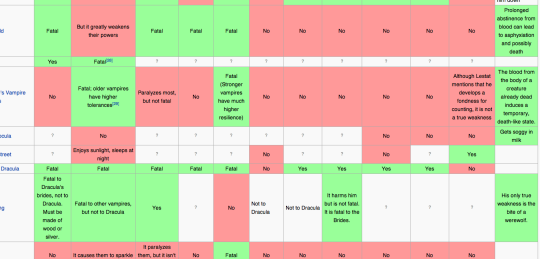
so im trying to decipher this chart on wikipedia that has common vampire weaknesses in it and
a ‘green/yes’ is a weakness, a ‘red/no’ is something that isnt a weakness, and a ‘?’ is something that has never been addressed but fucking riddle me this
in what lore are vampires weak to getting soggy in milk
i scrolled over to check to see what this could possibly be and
places a hand on me cheek
happy halloween month time for my favourite post of all time
Now a new study looking at 400,000 youths from 88 countries around the world suggests such bans are making a difference in reducing youth violence. It marks the first systematic assessment of whether an association exists between a ban on corporal punishment and the frequency in which adolescents get into fights. And, says Frank Elgar, the study’s lead author and an associate professor at the Institute for Health and Social Policy at McGill University in Montreal, “The association appears to be fairly robust.” The study appeared in the online journal BMJ Open.
Of the countries included in the study, 30 have passed laws fully banning physical punishment of children, both in schools and in homes. The rates of fighting among adolescents were substantially lower than in the 20 countries with no bans in place: by 69 percent for adolescent males and 42 percent less for females.
The other 38 countries in the study — which include the United States, Canada, and the U.K. — have partial bans, in schools only. In those countries, adolescent females showed a 56 percent lower rate of physical fighting, with no change among males.
The association held true even after accounting for such factors as the differences in the wealth of the countries and the nation’s homicide rates, said Elgar. Even so, Elgar cautions, the study shows a correlation only, not a cause and effect.
“It could be that bans come into place in countries that have already generally accepted that spanking is not the best discipline method,” he said, or there may be other cultural factors involved. “We haven’t answered with certainty” the impact of the bans, he says, noting that more research is needed.
What research does show is the negative consequences of spanking. Physical discipline is not only ineffective, but it can also cause harm, says Elizabeth Gershoff, a professor of human development and family sciences at the University of Texas at Austin who has been studying the impact of physical punishment on children for 20 years.


















 AlexTheGhost